 Maple
Maple Maple net revenue and the SYRUP buyback budget
Maple sets its SYRUP buyback budget by applying the applicable revenue-band percentage to finalized monthly net revenue. Under MIP-021, net revenue means total protocol fees minus interest paid to lenders. The calculation determines purchase funding, while execution prices determine how many tokens the Syrup Strategic Fund acquires.
SYRUP holdings and lending returns
SYRUP gives holders a role in governance, while lending positions earn portfolio returns funded partly by the interest excluded from the buyback revenue base. Evaluating repurchases concerns protocol capital allocation, while choosing a lending position involves its credit exposure and withdrawal conditions. The percentage assigned to buybacks describes purchase funding rather than an annual yield on an individual token holding.
Net revenue as the budget base
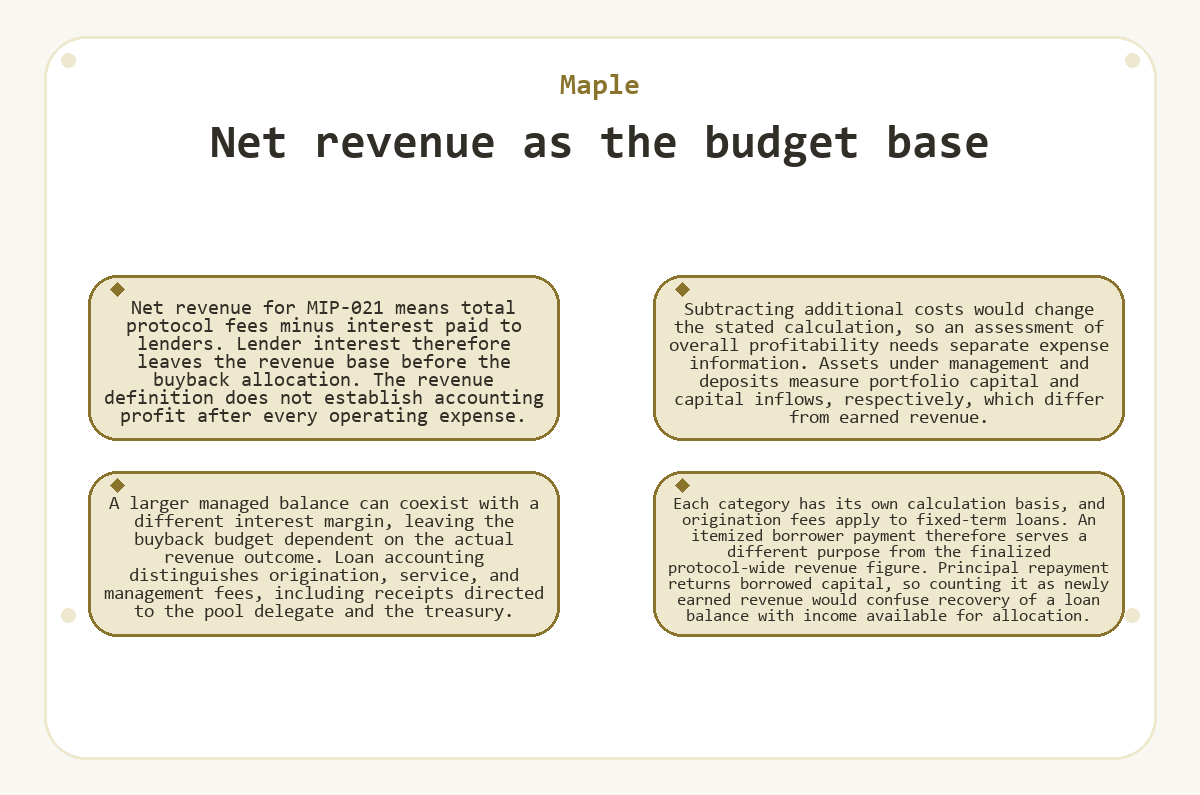
Net revenue for MIP-021 means total protocol fees minus interest paid to lenders. Lender interest therefore leaves the revenue base before the buyback allocation.
The revenue definition does not establish accounting profit after every operating expense. Subtracting additional costs would change the stated calculation, so an assessment of overall profitability needs separate expense information. Assets under management and deposits measure portfolio capital and capital inflows, respectively, which differ from earned revenue. A larger managed balance can coexist with a different interest margin, leaving the buyback budget dependent on the actual revenue outcome.
Loan accounting distinguishes origination, service, and management fees, including receipts directed to the pool delegate and the treasury. Each category has its own calculation basis, and origination fees apply to fixed-term loans. An itemized borrower payment therefore serves a different purpose from the finalized protocol-wide revenue figure.
Principal repayment returns borrowed capital, so counting it as newly earned revenue would confuse recovery of a loan balance with income available for allocation.
A single rate across the monthly total
One revenue band selects the percentage applied to the entire month’s net revenue; a marginal-bracket calculation would instead apply separate percentages to portions of that amount. Net revenue growth within a band raises the budget proportionally, and crossing a threshold can change the percentage applied to the whole total.
The governing framework supplies the thresholds and percentages; monthly financial reporting supplies the revenue input. Because governance can change these settings, a comparison across periods needs the applicable terms rather than assuming an earlier allocation percentage continues indefinitely.
Monthly allocation matched to completed spending
Reconciling an allocation starts with finalized monthly net revenue and its applicable governance rate, whose product gives the expected SYRUP purchase budget. The completed buyback entry then supplies spending and acquisition information for comparison.
| Parameter | Calculation or destination | Applies to |
|---|---|---|
| Revenue basis | Protocol fees minus lender interest | The finalized accounting month |
| Allocation method | One rate multiplied by monthly net revenue | The whole monthly total |
| Repurchased asset | SYRUP held in the Syrup Strategic Fund | Tokens acquired through the program |
| Allocated spending and acquired SYRUP are separate quantities in the same buyback. | ||
For a month under review, let R denote net revenue and r denote its applicable allocation rate. The expected budget is R multiplied by r, expressed in the revenue figure’s monetary units. Compare this amount with completed spending assigned to that revenue month. A purchase executed in the following month can still belong to the earlier accounting period. The token count provides a separate measure of what the fund acquired. Matching the dates and monetary basis keeps the comparison focused on the allocation.
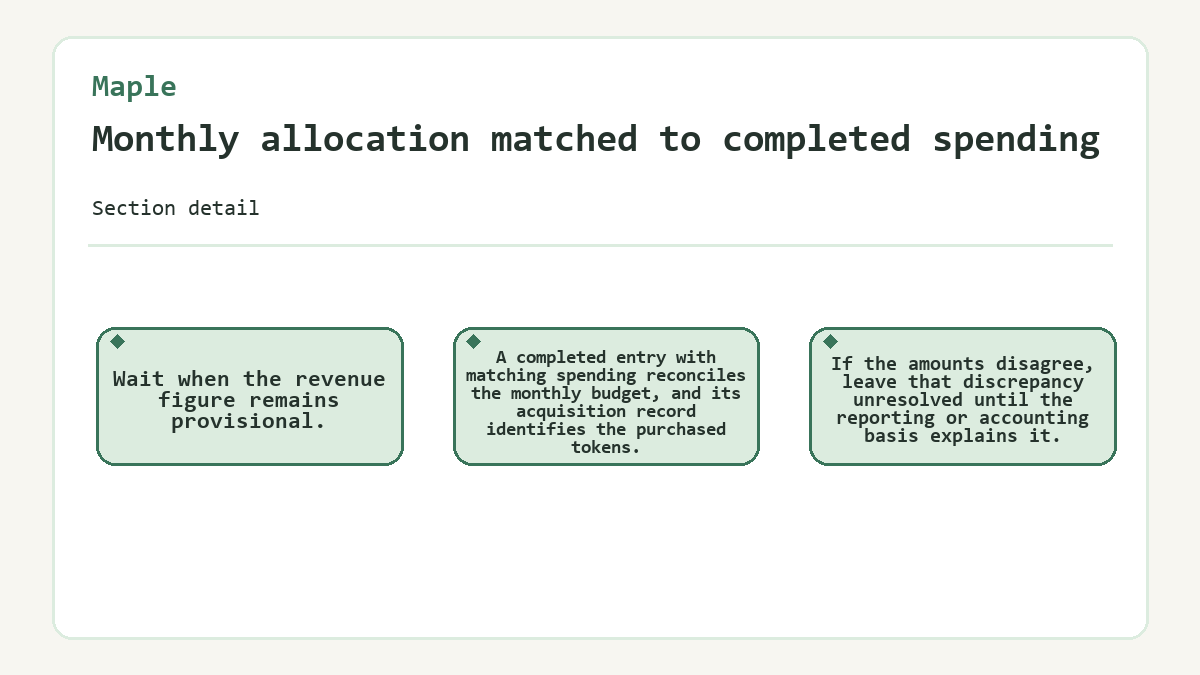
Wait when the revenue figure remains provisional. A completed entry with matching spending reconciles the monthly budget, and its acquisition record identifies the purchased tokens. If the amounts disagree, leave that discrepancy unresolved until the reporting or accounting basis explains it.
Month-end accounting and purchase execution
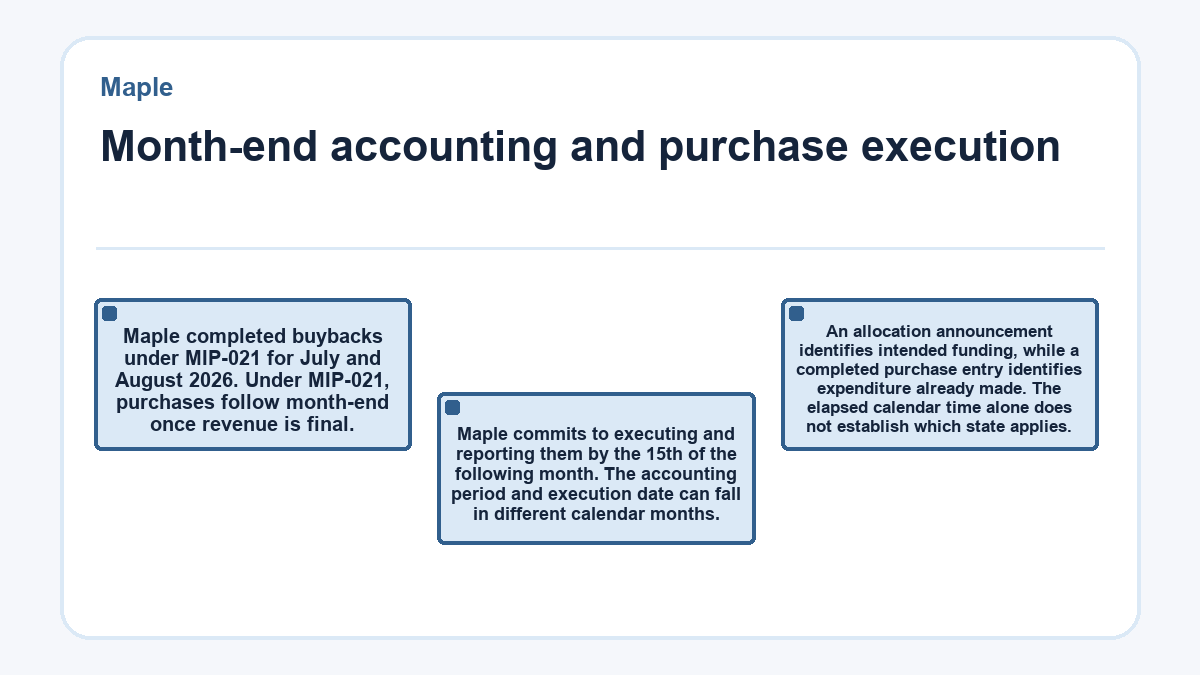
Maple completed buybacks under MIP-021 for July and August 2026. Under MIP-021, purchases follow month-end once revenue is final. Maple commits to executing and reporting them by the 15th of the following month. The accounting period and execution date can fall in different calendar months.
An allocation announcement identifies intended funding, while a completed purchase entry identifies expenditure already made. The elapsed calendar time alone does not establish which state applies.
SSF holdings and the earlier reward model
The Syrup Strategic Fund retains acquired SYRUP as treasury assets. Its mandate also includes strategic opportunities, token liquidity, and capital reserves. Treasury ownership and burning have different effects: a purchase changes who holds existing tokens, while a burn retires tokens from supply. The amount purchased therefore cannot serve as an automatic measure of permanent supply reduction.
Earlier buybacks supported distributions to stakers until MIP-019 ended that model and activated fund-oriented revenue allocation. The protocol sunset staking rewards, and the staking interface subsequently supported unstaking. The destination of repurchased tokens changed, even though repurchasing SYRUP remained part of the capital allocation approach.
MIP-020 extended SSF funding through the first half of 2026 under a framework combining buybacks with other balance-sheet uses. Comparing its fund allocation with a later dedicated purchase allocation compares different categories of spending. The headline percentages alone cannot resolve whether the amount committed specifically to purchases increased.
The fund owns the repurchased assets. A monthly purchase does not allocate a corresponding token balance or cash payment to each holder’s wallet.
Spending totals and purchased token counts
The number of SYRUP acquired reflects spending and execution prices, so a larger budget can purchase fewer tokens if acquisition prices rise enough. Comparing months by token count alone therefore cannot reveal whether revenue allocation increased.
Average execution price relates total spending to purchased quantity in matching units and describes those completed trades. A later market quote belongs to a different valuation date and can change the value of the holdings without changing their recorded acquisition cost. Comparing execution efficiency requires the spending and quantity from the same purchase activity, rather than combining a historical acquisition total with a later quote.
Market selling can outweigh buyback demand. The funding rule controls revenue allocation; it does not set a floor under SYRUP’s market price.
Repurchases and retaining liquid capital
Completed repurchases turn allocated revenue into SYRUP holdings and change the treasury’s asset mix. Dedicating revenue to those purchases leaves less of the same month’s income available for other uses. The SSF’s wider mandate keeps reserve building and strategic allocation part of the capital decision. A revenue-based commitment favors repeatable purchase funding. Buying SYRUP increases the fund’s token position and its exposure to subsequent price changes; retaining the allocation as liquid capital keeps that spending capacity available for future purchases or other treasury uses.
Quick answers about Maple
-
Can annualized revenue replace monthly net revenue in the SYRUP buyback calculation?
- Annualized revenue cannot replace the finalized monthly input. An annualized figure estimates a yearly pace, often by extrapolating a shorter period. Dividing it into monthly portions would produce an estimate rather than the actual revenue used to select that month’s allocation band.
-
Can the SSF’s total SYRUP balance reveal one month’s buyback size?
- The fund’s total balance cannot isolate one month’s purchases. It measures holdings accumulated through the fund’s history, including assets predating that allocation. The monthly acquisition entry identifies the relevant purchase quantity. A balance change can also reflect other fund activity, so it is a different measurement.
-
Are loan management fees and the SYRUP buyback share calculated on the same base?
- Management fees and buyback allocations use different calculation bases. Loan management fees take a portion of gross borrower interest under the applicable fee parameters. The buyback share applies to monthly net protocol revenue. An identical percentage would still describe different amounts because the underlying bases differ.
-
Is a token transfer required to read Maple’s buyback figures?
- Public revenue and buyback figures can be read without transferring SYRUP. Reproducing the budget calculation only requires the relevant reported figures and allocation rule. Sending tokens or approving a token allowance does not help reconcile public spending with the revenue funding it.
-
Which holders can vote on changes to the buyback framework?
- Both SYRUP and stSYRUP holders are eligible to participate in governance voting. Each proposal’s voting settings determine the balance and participation requirements for that ballot. Voting eligibility gives holders a role in policy decisions; it does not create a personal claim for a share of a monthly repurchase.
-
Will MIP-021’s buyback policy apply indefinitely?
- MIP-021 specifies a time-limited framework. Allocations for later periods follow the continuation or replacement policy governance authorizes. Extending the original terms beyond their approved period would assume a future policy decision, so the original framework alone cannot establish those later budgets.