 Maple
Maple onchain asset management and secured lending
Maple is an onchain asset manager whose lending products connect secured institutional financing with yield-bearing pool shares. Its core credit business uses overcollateralized loans, meaning borrowers post collateral worth more than the loan. Access ranges from permissioned institutional pools to the decentralized finance (DeFi) assets syrupUSDC, syrupUSDT, and syrupUSDG. Yield reflects lending and permitted supporting strategies, while repayment risk and available liquidity shape the value and timing of an exit.
Institutional pools and liquid yield-bearing assets
Institutional pools combine identity-checked lender access with a managed loan portfolio. Blue Chip Secured lending restricts collateral to BTC and ETH held in qualified custody. High Yield Secured lending uses selected digital-asset collateral and can reinvest it in staking or secured lending. The latter approach introduces additional deployment exposure alongside the original loan. Those strategy differences affect the assets backing repayment, even when both products involve secured credit.
The DeFi products issue syrupUSDC, syrupUSDT, or syrupUSDG in exchange for deposits in the corresponding stablecoin. Each token represents a proportional interest in its pool’s assets. Transferability allows those positions to enter other applications, subject to the particular integration. Direct institutional pool shares carry their own permissioning, so a DeFi product’s composability should not be assumed for every institutional pool. Holding a deposit stablecoin without lending preserves exposure to its issuer without adding the pool’s credit strategy. A pool share introduces exposure to the deployed portfolio. Loan selection and liquidity terms therefore become part of the ownership decision, alongside the underlying stablecoin’s own risks.
Which requirements apply to direct deposits?
Direct deposits require an eligible participant, the pool’s accepted asset, and the permissions the selected contract enforces. The Syrup products exclude the United States, Australia, and other restricted jurisdictions. For individuals, restrictions apply to residence, citizenship, tax residence, and access location. Entity restrictions also cover incorporation, organization, and principal place of business. Connecting a supported wallet does not establish jurisdictional eligibility.
Institutional lending adds know-your-customer (KYC) checks, investor-qualification conditions, and wallet allowlisting. SyrupRouter handles an authorization path for eligible DeFi deposits. A router method can combine first-deposit authorization with the deposit transaction, so authorization and deposit remain distinct operations even when execution combines them.
Token approval gives the contract permission to spend the deposit asset. Approval alone does not transfer that asset into the pool or establish a lending position.
A finalized deposit exchanges the lending asset for a position represented by pool shares. Successful deposit execution and issued shares establish a lending position; a wallet connection or allowance record establishes a different state. Redemption terms govern later access to the deposited value.
Product parameters and entry conditions
USDC, USDT, and USDG belong to different deposit pools. Institutional access requirements also differ from the authorization path used by SyrupRouter. The share standard defines accounting interfaces, while permissions determine which wallets can use a particular pool. Neither property fixes the pool’s changing yield or cash balance.
| Product parameter | Documented value or mechanism | Required access or inputs |
|---|---|---|
| syrupUSDC deposit asset | USDC | Eligible account and token-spending authorization |
| syrupUSDT deposit asset | USDT | Eligible account and token-spending authorization |
| syrupUSDG deposit asset | USDG | Eligibility and the corresponding pool’s deposit permissions |
| Ethereum pool share standard | ERC-4626 tokenized vault | The pool’s underlying asset and applicable permissions |
| Institutional deposit permission | KYC and wallet allowlisting | Pool eligibility and identity approval for the depositing wallet |
| Syrup withdrawal processing | Liquidity-dependent withdrawal queue | Available underlying assets for processing |
| Collateral coverage calculation | Collateral value divided by loan value | Both values measured on a comparable valuation basis |
| Selection basis | Match the deposit asset to the product. | Access permission and withdrawal liquidity remain separate requirements. |
Where does the yield come from?
Borrower interest provides the main lending return, with supporting strategies contributing where the pool allocates capital to them. A loan can carry a fixed interest rate while the pooled return changes with deployment, available liquidity, borrower payments, and expenses. The pool’s annual percentage yield (APY) reflects aggregate performance, so a fixed loan rate does not fix its overall return.
Supporting allocations can include DeFi liquidity provision and futures basis trading. Basis trading seeks a return from the difference between spot and futures prices; narrowing or inverted spreads can reduce that return. Such exposure introduces trading and counterparty risks beyond borrower repayment. A pool’s allocation breakdown identifies which activities contribute to its assets.
Management fees come out of gross borrower interest before net interest reaches liquidity providers. DeFi strategy performance fees apply to earned strategy yield, with administrative settings controlling applicable fee rates. Origination fees apply to fixed-term loan funding and refinancing; service fees follow the loan’s payment terms. The borrower’s financing cost and a lender’s net return therefore measure different outcomes. Base yield and incentive rewards also have different sources. Lending income comes from portfolio activities, while a rewards program sets its own qualification and distribution conditions. A changing incentive offer does not change the underlying deposit asset or remove the credit exposure of the pool shares.
Collateral, impairments, and lender losses
Overcollateralization supplies a recovery buffer because borrowers post assets worth more than their borrowing at the required coverage level. The buffer’s value moves with collateral prices. Margin calls can require additional collateral, and liquidation converts pledged assets into recovery proceeds. A sharp price decline or slow liquidation can leave those proceeds below the debt.
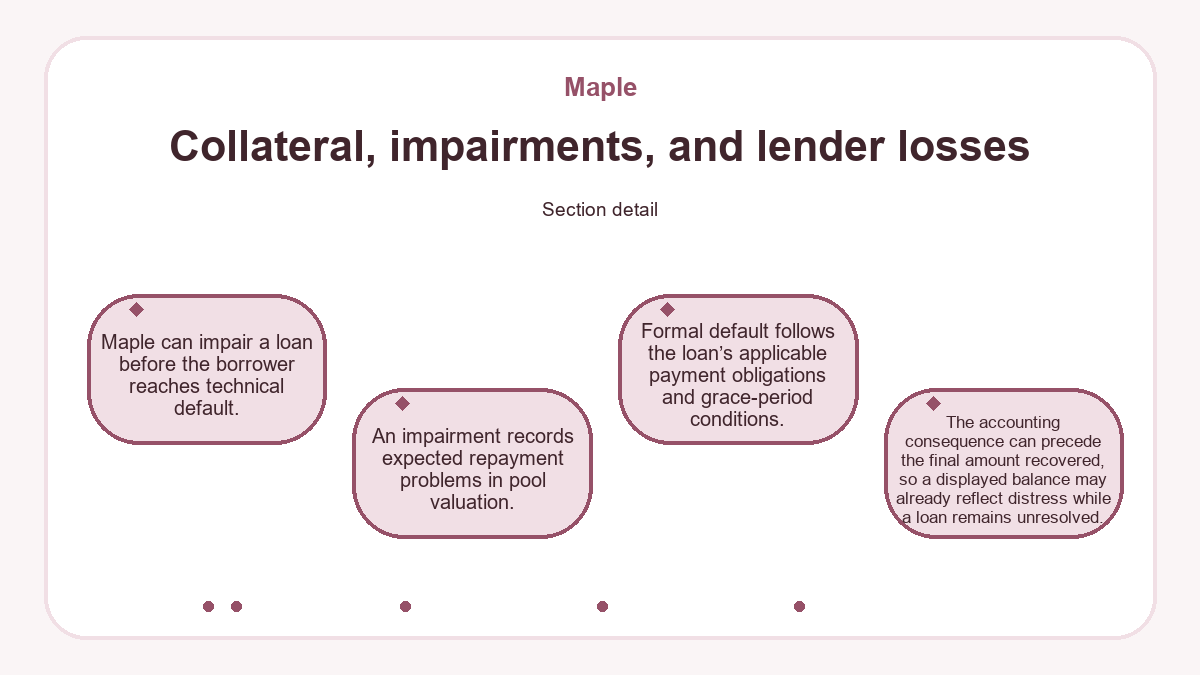
Maple can impair a loan before the borrower reaches technical default. An impairment records expected repayment problems in pool valuation. Formal default follows the loan’s applicable payment obligations and grace-period conditions. The accounting consequence can precede the final amount recovered, so a displayed balance may already reflect distress while a loan remains unresolved.
Deposit and exit exchange rates can diverge during an impairment. Exit accounting subtracts recorded unrealized losses, while deposit accounting excludes that subtraction. This prevents incoming depositors from gaining the recovery value belonging to existing lenders through a depressed entry valuation. A deposit conversion therefore does not necessarily describe the assets available on exit. Redeeming shares during an impairment locks in the impairment loss on those shares and forfeits later recoveries on that loan for the redeemed portion.
Smart contract security addresses another category of loss. Code audits review implementation, while administrative permissions control upgrades and sensitive settings. A contract exploit can cause losses even when borrowers meet their loan obligations.
What determines when withdrawals complete?
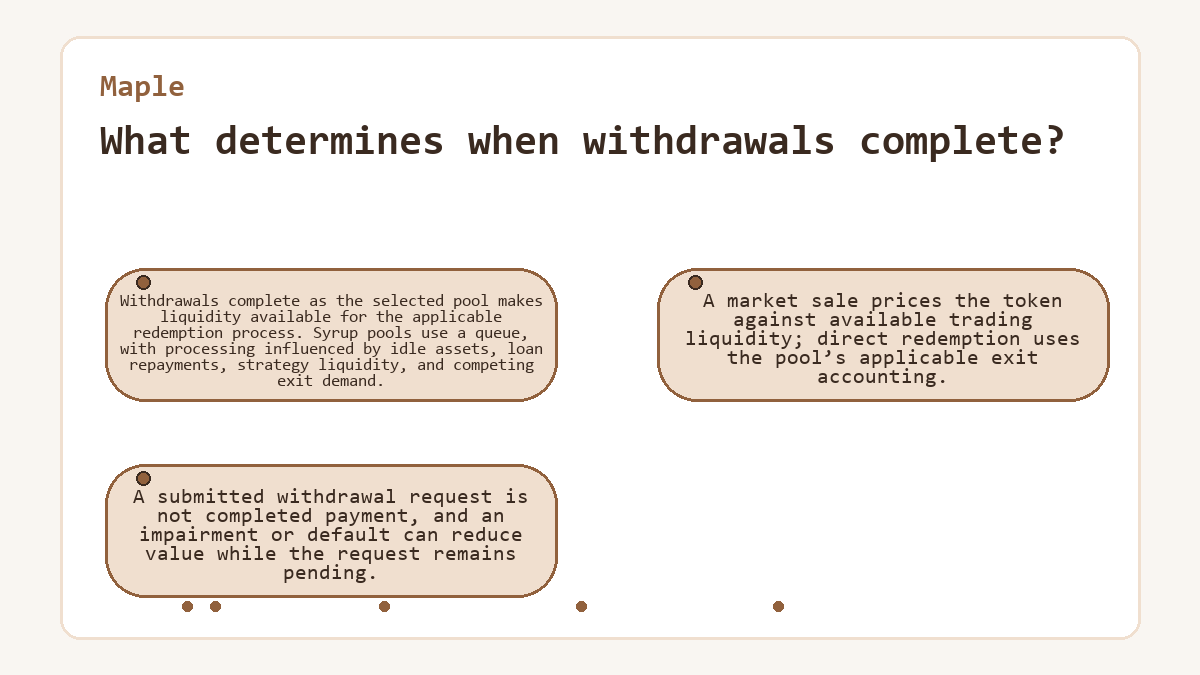
Withdrawals complete as the selected pool makes liquidity available for the applicable redemption process. Syrup pools use a queue, with processing influenced by idle assets, loan repayments, strategy liquidity, and competing exit demand. A market sale prices the token against available trading liquidity; direct redemption uses the pool’s applicable exit accounting. A submitted withdrawal request is not completed payment, and an impairment or default can reduce value while the request remains pending.
Borrower financing and the Borrower Hub
Borrowing requires institutional onboarding and a credit review before the borrower and Maple agree the loan’s legal and economic terms. The process includes know-your-business (KYB) and KYC checks, entity documentation, a master lending agreement, and loan-specific terms. Funding is a separate stage from account access, and an accepted loan proposal can remain pending funding.
Within the Borrower Hub, loan health shows collateral value relative to loan-to-value (LTV) thresholds. Payment status tracks interest obligations separately from collateral health. The interface also shows proposed terms, active facilities, refinancing proposals, and repayment states. Sufficient collateral does not settle an overdue interest payment. The Hub supports accepting loans, paying interest, accepting negotiated refinances, and repaying principal when the loan permits repayment. Maple initiates refinance proposals after offline agreement; borrowers do not initiate them from the Hub. Wallet authorization and user roles determine who can execute particular actions, and the governing terms determine margin call and repayment conditions.
SYRUP governance and DeFi integrations
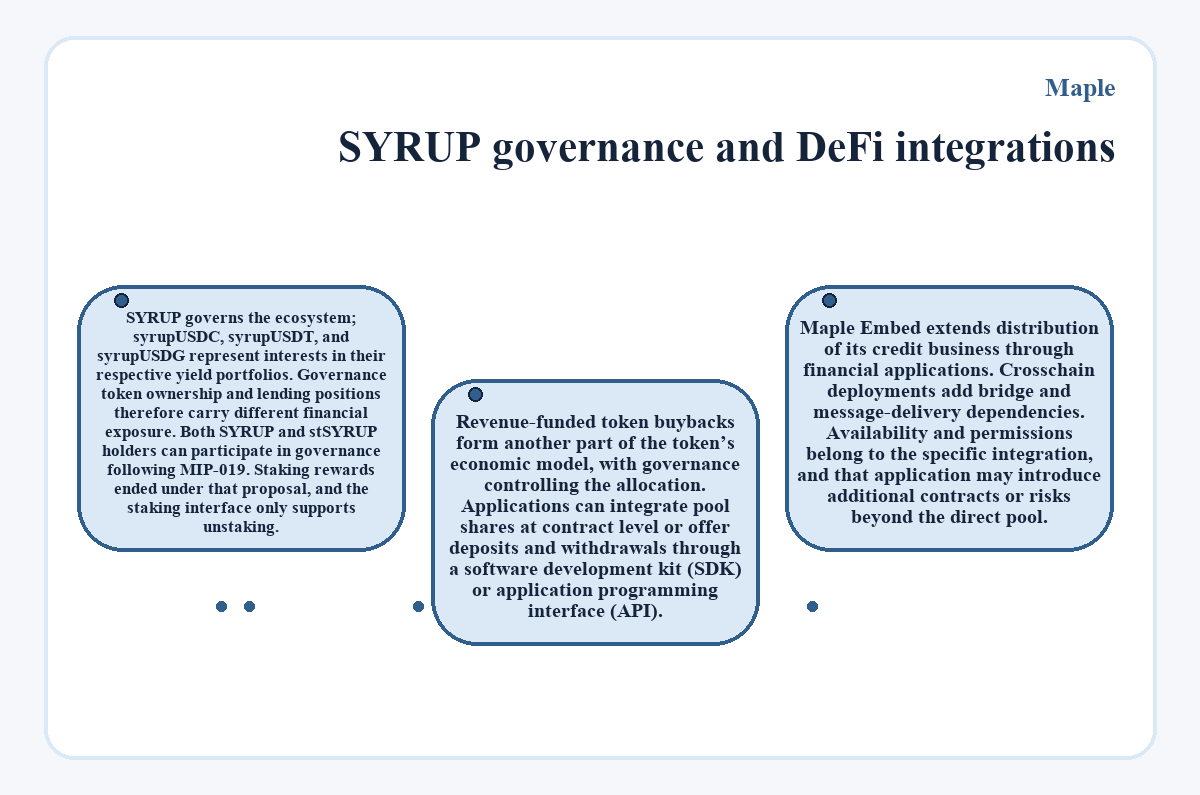
SYRUP governs the ecosystem; syrupUSDC, syrupUSDT, and syrupUSDG represent interests in their respective yield portfolios. Governance token ownership and lending positions therefore carry different financial exposure.
Both SYRUP and stSYRUP holders can participate in governance following MIP-019. Staking rewards ended under that proposal, and the staking interface only supports unstaking. Revenue-funded token buybacks form another part of the token’s economic model, with governance controlling the allocation.
Applications can integrate pool shares at contract level or offer deposits and withdrawals through a software development kit (SDK) or application programming interface (API). Maple Embed extends distribution of its credit business through financial applications. Crosschain deployments add bridge and message-delivery dependencies. Availability and permissions belong to the specific integration, and that application may introduce additional contracts or risks beyond the direct pool.
Useful questions about Maple
Do syrupUSDC, syrupUSDT, and syrupUSDG share one Ethereum deposit router?
The Ethereum pools for syrupUSDC, syrupUSDT, and syrupUSDG use separate SyrupRouter contracts. A router links to its own pool and underlying deposit asset. Integrations need the matching contracts on the selected deployment; the token’s ticker and vault standard do not identify that contract relationship.
Can institutional pool shares move to another wallet?
An allowlisted receiving wallet is necessary for a permissioned institutional share transfer. The institutional interface terms also require lenders to retain full control of recipient wallets. A transfer to an address outside the Global Allowlist reverts. These conditions concern permissioned institutional shares and do not establish identical transfer restrictions for Syrup’s DeFi assets.
Is syrupUSDC guaranteed by the issuer of USDC?
Circle does not guarantee syrupUSDC or the performance of its underlying loans. Depositing USDC produces a share of a managed asset pool, whose value depends on its loans and other permitted strategies. The deposited stablecoin and the resulting pool share therefore have different backing and risks. Credit losses can reduce the pool share’s redemption value.
Why can my token count stay unchanged while the position earns yield?
Pool shares accrue yield through the assets each share represents, so earning interest does not require the wallet’s share count to increase. The asset-equivalent position changes with the pool’s accounting and conversion rate. Token quantity alone cannot describe the lending balance, and exit valuation can differ from deposit valuation when the pool records unrealized losses.
What happened to the Drips rewards program?
Drips ended after Q4 2025, and its final claim window closed on February 18, 2026. Drips left unclaimed after that deadline cannot be claimed. Partner-based incentives distributed through Merkl replaced the points program for syrupUSDC and syrupUSDT. Participation and rewards follow the applicable partner offer, separately from the income the lending pool earns.
Does a Borrower Hub email login authorize onchain loan actions?
An email login does not, by itself, authorize loan transactions. Executing Hub actions requires two-factor authentication and an appropriate user role. Accepting a new loan, receiving funds, accepting a refinance, or repaying principal also requires a wallet registered to the legal entity holding the loan. Interest can be paid from any wallet. The wallet’s own signing requirements still apply separately from the Hub’s role permissions.
Which lending data can an application retrieve through the API?
Maple’s GraphQL API exposes collateral values, loan values, assets under management, and yield history. Queries can cover aggregate lending data or specific pool and account records. Integrations must preserve that scope and decode the documented decimal scales. Raw integer fields are not display-ready amounts or percentages.
Are one Syrup portfolio’s assets available to cover another portfolio’s losses?
The syrupUSDC, syrupUSDT, and syrupUSDG portfolios keep their assets and liabilities legally separate. A lender’s claim attaches to the relevant segregated portfolio, and another portfolio’s assets cannot satisfy it. This separation limits cross-portfolio recourse; it does not insulate the selected portfolio from its own loan losses or other investment risks.